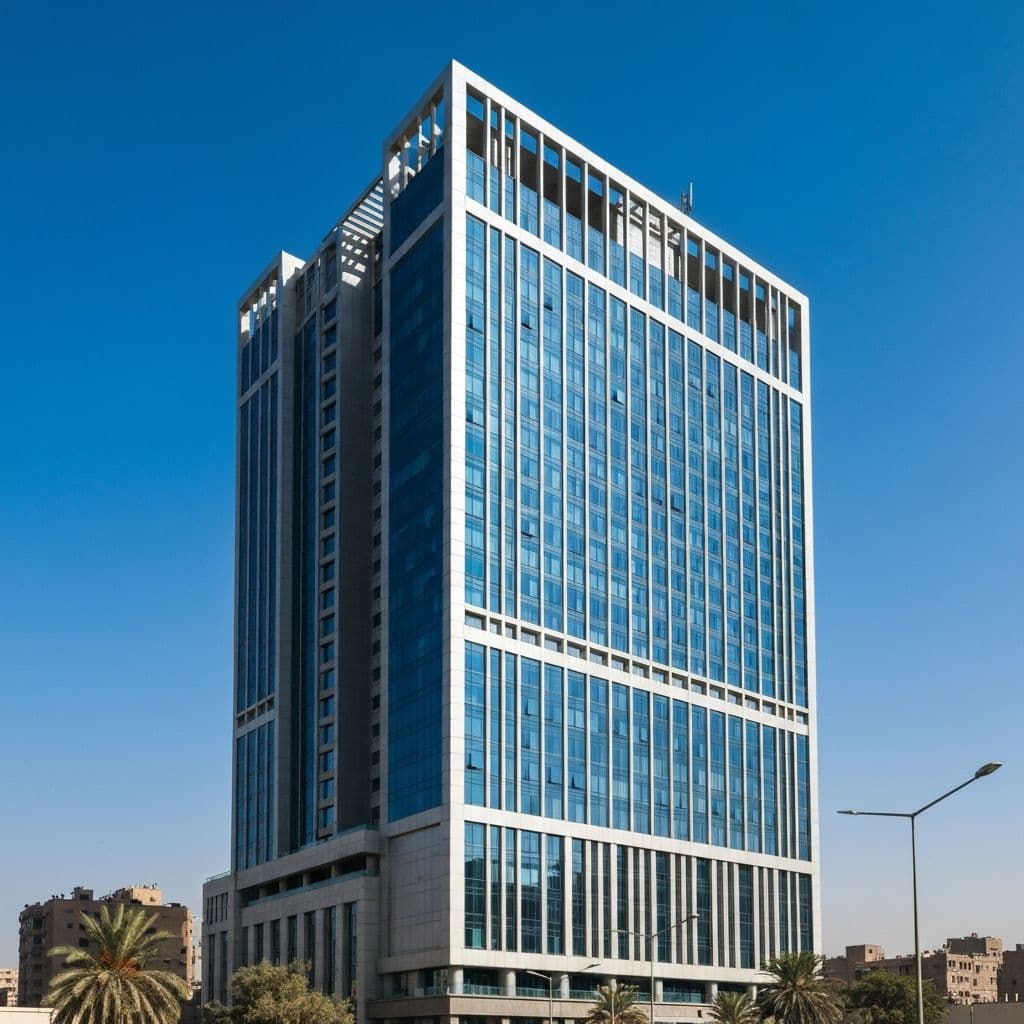

The right foundation in Egypt depends on three things: the soil beneath the site, the groundwater level and the loads the building will carry. Isolated or strip footings suit firm soil and moderate loads, raft foundations suit weaker soils or basements, and piles suit sites where good bearing soil is deep. A soil investigation decides which applies.
Foundations are the least visible part of a building and the hardest to fix. A wrong choice shows up years later as settlement, cracked walls and doors that no longer close. This guide explains each foundation type in plain terms so you can follow your engineer's recommendation and ask the right questions.
Why does the soil decide the foundation?
A foundation's job is to pass the building's weight into the ground without the ground failing or settling too much. Different soils carry very different loads. Dense sand or rock can support heavy loads close to the surface. Soft clay or loose fill may barely support a light structure.
Egypt has a wide range of ground conditions. Coastal areas and the Nile Delta often have soft clays and a high water table. Some desert sites have expansive or collapsible soils that move when their moisture content changes. Two plots in the same city can need different solutions, which is why the foundation should never be copied from a neighbouring building.
What does a soil investigation tell you?
A soil investigation (geotechnical investigation) usually includes boreholes drilled across the site, samples taken at depth and laboratory testing. The report gives the engineer:
- The soil profile. Each layer, its depth and its type.
- Allowable bearing capacity. How much pressure each layer can safely take.
- Expected settlement. How much the ground will compress under load.
- Groundwater level. Which affects excavation, dewatering and waterproofing.
- Chemical aggressiveness. Sulphates and chlorides that attack concrete and steel reinforcement.
- A foundation recommendation. The suitable type and founding depth.
Foundation design in Egypt follows the Egyptian Code (ECP) for soil mechanics and foundations, alongside relevant international standards. The structural engineer uses the soil report and the building loads to size the foundation.
What are the main foundation types?
| Foundation type | How it works | Typical use | Main limitation |
|---|---|---|---|
| Isolated footing | A separate reinforced concrete pad under each column | Low- and mid-rise frames on firm soil | Unequal settlement on variable or weak soil |
| Strip footing | A continuous strip under a line of columns or a load-bearing wall | Wall-bearing buildings, closely spaced columns | Needs reasonably firm soil along its length |
| Combined footing | One pad carrying two or more columns | Columns near a boundary or close together | Design is more complex than single pads |
| Raft (mat) foundation | One continuous slab under the whole building | Weaker soil, heavier loads, basements | More concrete and reinforcement than footings on good soil |
| Piles | Columns of concrete or steel taking load to deeper layers | Soft surface soils, tall or heavy buildings | Higher cost and specialist equipment |
Isolated and strip footings
Shallow footings are the most common choice for villas, low-rise residential buildings and light commercial buildings on good soil. Isolated footings are usually linked by tie beams that hold the column bases together and help resist differential movement. Strip footings follow walls or rows of columns. Both are economical because they use relatively little concrete and need no specialist plant.
Raft foundations
A raft (known locally as a لبشة) spreads the load over the full footprint of the building, which lowers the pressure on the soil. Engineers choose a raft when the soil is too weak for separate footings, when the footings would be so large that they nearly merge, or when a basement needs a continuous slab that can be waterproofed.
Piled foundations
Piles (خوازيق) are used when the strong soil is too deep for shallow foundations. Bored cast-in-place piles are common in Egypt. They carry load through end bearing on a firm layer, through friction along their sides, or both. A pile cap or a piled raft connects the piles to the columns above. Pile load tests are normally carried out to confirm the design capacity.
How do groundwater and aggressive soils change the design?
Groundwater affects more than the choice of foundation type. A high water table means the excavation may need dewatering during construction. Basements and rafts below the water level need a proper waterproofing system and must resist uplift.
Coastal and saline soils can contain sulphates and chlorides that attack concrete and corrode reinforcement. The response is a combination of the right cement type, a dense concrete mix, adequate concrete cover and protective coatings or membranes. These decisions belong in the design and the specification, not on site.
What are the most common foundation mistakes?
- Skipping the soil investigation to save time or money.
- Copying a foundation from a neighbouring plot.
- Ignoring groundwater until excavation starts.
- Using the wrong cement for aggressive soils.
- Poor compaction of fill beneath slabs and footings.
- Changing column positions without rechecking the foundation.
Each of these is cheaper to avoid at design stage than to repair after the building is up.
How does the foundation fit into the whole project?
The foundation is the first construction stage and sets the pace for everything after it. On the residential duplex in 5th Settlement, Cairo, Laurent's scope ran from foundation works through to interior fit-out and finishing, with one team responsible for every stage.
For heavy or long-span buildings, the foundation design is also tied to the superstructure. A steel structure is lighter than an equivalent concrete frame and puts different loads on its foundations, including uplift and horizontal forces at the column bases. You can read more about how Laurent approaches excavation, footings, rafts and piling on the foundation works page.
Build on the right foundation
If you have a plot and a building in mind, start with the ground. Laurent is Alexandria-based and delivers foundation and construction works across Egypt. Start your project and share your site details and any soil report you already have.